

Virbac's C.E.T. AQUADENT FR3SH earns a rare third-party seal and for the majority of dog owners who cannot get their pet to sit still for a toothbrush, it is good news.
For many dog owners, the dental care conversation usually ends in guilt and surrender. This product announcement may offer a more realistic path forward — but only because an independent body, not the manufacturer, says it works.
Virbac has announced that its C.E.T. Aquadent Fr3sh dental solution has earned the Veterinary Oral Health Council (VOHC) Seal of Acceptance for plaque and tartar control in dogs. The VOHC is overseen by the American Veterinary Dental College and evaluates products through independently reviewed clinical trials, a standard that most pet dental products never meet.
According to the American Humane Society, citing the American Veterinary Dental College in 2026, more than 80% of dogs show signs of periodontal disease by age three. That figure gives the VOHC certification real urgency.
"Earning VOHC acceptance for C.E.T. AQUADENT FR3SH is a milestone that reflects our unwavering commitment to delivering scientifically proven oral care solutions for pets." — Gio Abruzzini, President and CEO, Virbac North America
• C.E.T. Aquadent Fr3sh Solution has received the VOHC Seal of Acceptance for both plaque and tartar control in dogs.
• The product works as a water bowl additive, requiring no brushing or direct application to the dog's mouth.
• The VOHC is overseen by the American Veterinary Dental College and evaluates efficacy through independently reviewed trials, not manufacturer-submitted data alone.
• The active ingredients — erythritol, inulin, and pomegranate extract — are described by Virbac as natural, though independent long-term safety data is not cited in the announcement.
• The product is available through veterinary clinics and online retailers.
The Silent Epidemic in Your Dog's Mouth
Periodontal disease in dogs is not a fringe concern. It is, by most veterinary measures, a near-universal one. The condition causes pain, tooth loss, and in severe cases has been linked to systemic health complications affecting the heart and kidneys.
Yet the solution most veterinarians recommend, daily tooth brushing, is one that most owners do not follow. According to the AKC Canine Health Foundation in 2025, two-thirds of dog owners neglect their pet's dental hygiene entirely. The gap between what veterinary science recommends and what happens in the average home is wide and persistent. Into that gap, the pet industry has poured a flood of sprays, chews, gels, and additives, most of them carrying only the manufacturer's own claims of efficacy.
 Edvarcl H
That is what makes third-party certification meaningful. The VOHC does not accept a company's word. It requires clinical trial data reviewed by an independent panel of veterinary dentists and dental scientists. Earning the seal is not routine. Failing to earn it is far more common than the pet product market would suggest.
What the Waterbowl Dog Dental Additive Actually Contains
The dental solution is added directly to a dog's water bowl as part of a daily oral care routine. The mechanism is passive, as the dog drinks, the active ingredients do their work. There is no restraint required, no applicator to wrestle with, and no flavored toothpaste to coax a reluctant animal to accept.
The product is built around Virbac's proprietary tTechnology, which combines three active ingredients: Erythritol, a sugar alcohol found naturally in some fruits; inulin, a prebiotic fiber derived from plants; and pomegranate extract, which has been studied in human oral health contexts for its antimicrobial properties. Virbac describes this combination as designed to disrupt plaque formation with daily use.
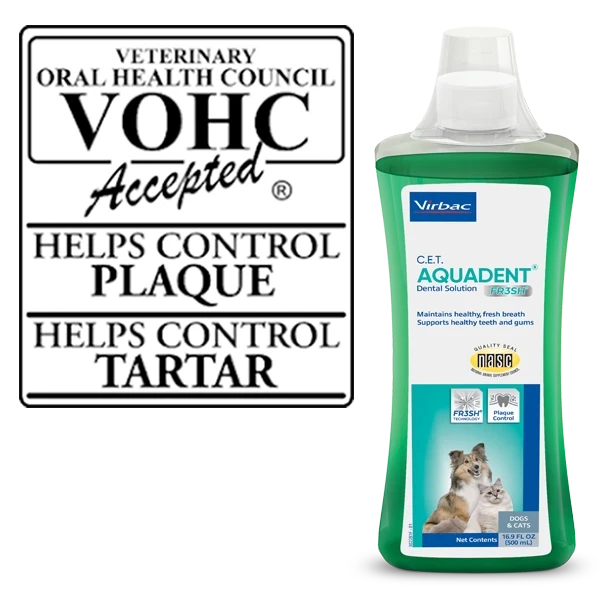
The product is formulated for both dogs and cats, though the VOHC seal announced this month applies specifically to dogs. No equivalent cat certification was mentioned in the announcement.
Plaque Prevention for Dogs: Why the VOHC Seal Is the Distinction That Matters
The Veterinary Oral Health Council was established to bring scientific accountability to a market that has historically been short on it. The organisation is overseen by the American Veterinary Dental College and its seal is granted only after independent review of clinical trial data demonstrating that a product meaningfully reduces plaque, tartar, or both.
For pet owners evaluating dental products at a pet supply store or online, the VOHC seal is one of the few reliable signals in a crowded and often misleading category. A product can legally claim to support oral health, freshen breath, or promote dental wellness without proving any of those things to an independent body. A product with the VOHC seal has passed a higher bar.
Virbac already holds VOHC acceptance for several products in its C.E.T. line. The addition of C.E.T. Aquadent Fr3sh to that list extends third-party credibility to the water additive category, a segment that has long been viewed with skepticism by veterinarians who preferred brushing or dental chews.
The Cost Pressure Behind Every Dental Decision
The timing of this announcement lands in a broader context of rising veterinary costs and declining access to care. Professional dental cleanings for dogs, which require general anaesthesia, can cost several hundred to over a thousand dollars — a figure that rises further if extractions are needed.
According to a PetSmart Charities and Gallup survey cited by the American Veterinary Medical Association in 2025, 52% of U.S. pet owners report having skipped needed veterinary care in the past year, with cost cited as a primary barrier. Preventive at-home care — including dental care — is increasingly framed by veterinary professionals as a way to reduce the frequency and severity of costly professional interventions. A water additive that genuinely controls plaque and tartar, independently verified, fits directly into that logic.
What the Announcement Does Not Tell Us
There is no mention of the percentage reduction in plaque or tartar observed, or the comparative performance against brushing or other VOHC-accepted products. It does not address long-term safety data for the three active ingredients when consumed daily by dogs over months or years. We have reached out to Virbac for further details.
What This Means If Your Dog Hates the Toothbrush
For the majority of dog owners — the two-thirds who, according to the AKC Canine Health Foundation in 2025, are not currently doing anything consistent for their dog's dental health — the practical message is straightforward. A water additive with VOHC acceptance is meaningfully different from one without it. This product has cleared a bar that most have not.
That does not make it a replacement for professional dental cleanings, which remain the gold standard for treating established periodontal disease. But as a daily preventive measure for dogs whose owners find brushing impractical, this product now has the kind of independent backing that makes a veterinarian's recommendation credible rather than speculative. Pet owners who have been dismissing water additives as unproven marketing may have reason to revisit that position and to ask their veterinarian whether this specific product fits their dog's needs.
In a market full of dental claims that never face that test, this distinction is worth paying attention to.