

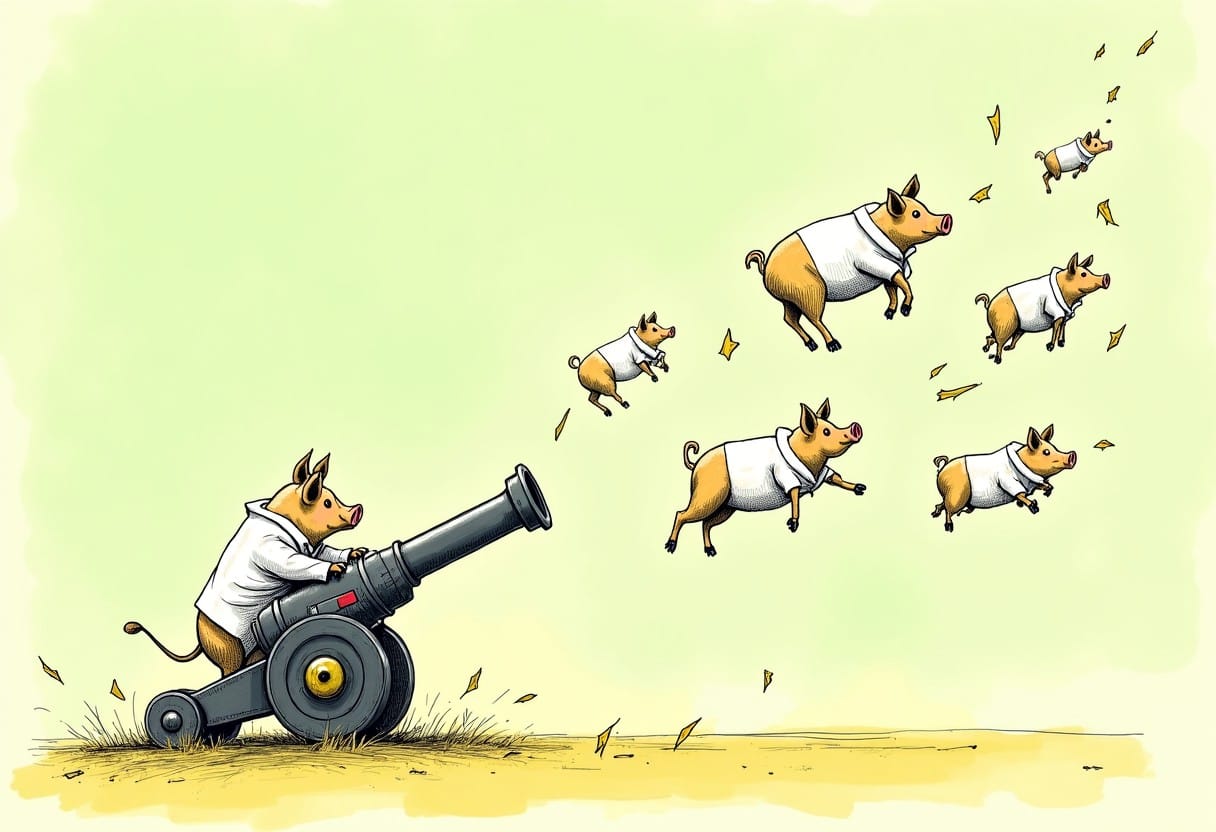
A 12-fold surge in fabricated references may threatens the veterinary research vet rely on — and the pet health content pet owners read online.
A landmark audit published on 7 May 2026, has confirmed what research integrity experts feared: Artificial intelligence is quietly flooding scientific databases with citations that point to studies that do not exist — and veterinary medicine may be indirectly in the crossfire.
• A May 2026 audit of 2.5 million biomedical papers found 1 in every 277 PubMed-indexed studies contains AI-fabricated citations, a 12-fold increase since the 2023 baseline.
• Fabricated citations look legitimate because AI mimics the exact structure of real references — but the studies they point to do not exist.
• Veterinary clinical guidelines are at risk: Review articles, which inform how vets treat your pets, have a fabrication rate 57% higher than other paper types.
• Pet owners reading health content online are vulnerable to trusting advice backed by fictional research, as fake citations are nearly indistinguishable from real ones at first glance.
The Breaking Discovery: A Number That Should Alarm Every Pet Owner
On May 7, 2026, a team led by Maxim Topaz, PhD, at Columbia University's Data Science Institute published findings in The Lancet that stopped the biomedical publishing world cold. Their automated audit scanned 2.5 million research papers and 126 million structured references within the PubMed Central Open Access subset. The result: One in every 277 indexed papers contained at least one AI-hallucinated citation — a reference to a study that has never existed.
00603-3/asset/9977e24b-3190-4968-9aeb-f7ddf01802c8/main.assets/gr1_lrg.jpg)
This is not a minor statistical blip. It represents a 12-fold increase from the fabrication rate first documented in 2023, when researchers William Walters and Esther Wilder of Manhattan College and the City University of New York first systematically tested whether ChatGPT invented its own sources. At the time, the answer was a troubling yes. By 2026, the scale had become an emergency.
"Clinicians have no way of knowing that the evidence they rely on doesn't exist." — Maxim Topaz, PhD, Columbia University, lead author of the 2026 Lancet audit
Topaz stated plainly for The Lancet that clinicians "have no way of knowing that the evidence they rely on does not exist" and that this discovery "directly impacts patients as medical professionals make treatment decisions based on clinical guidelines."
In his interview with CBS News, Topaz asserted that "fabricated citations are dangerous because they influence clinical guidelines, which are based on public research that health care professionals follow in providing care. Your doctor could be making decisions on treatments based on studies that never existed."
How AI Invents a Study From Thin Air
To understand why this is happening, it helps to understand what a large language model actually does. These tools are not search engines. They do not retrieve records from a database. Instead, as researchers Mehul Bhattacharyya and colleagues explained in 2023, they "use deep neural networks to predict the next word in a sequence" based on patterns learned during training. The model cannot distinguish between accurate and false information.
During training, words are converted into tokens and mapped into what researchers call a high-dimensional embedding space. Words that appear together frequently in published text — such as "Journal," "Veterinary," and "Research" — are positioned close together in this space. When asked for a citation, the model generates the most statistically plausible combination of words that fits the structure of a bibliographic reference. The result looks exactly like a real citation, with author names, a journal title, a volume number, page numbers, and a year of publication. None of it may be real.
This is what researchers Jocelyn Gravel and colleagues described as being "confidently wrong" in their 2023 study that evaluated the quality and appropriateness of the references provided by ChatGPT for medical questions. To a reader — including a trained veterinarian — the fake can look identical to the genuine article.

Why Vets' Bookshelves May Be Compromised: The AI Fake in Veterinary Medical Text
The specific danger for animal medicine lies in how clinical knowledge is built and transmitted. Veterinarians do not, and cannot possibly, read every primary research paper. They rely on review articles — comprehensive summaries of the existing literature — to understand best practices for diagnosis and treatment. The 2026 audit found that review articles carry a fabrication rate 57% higher than other paper types. The very documents most likely to shape clinical guidelines are the most contaminated.
The timing also makes this worse. The widespread adoption of AI writing tools occurred in late 2022 and through 2023. Academic publishing operates on a typical lag of 100 to 200 days from submission to publication. This means a wave of AI-assisted papers — some containing hallucinated references — began entering the indexed record in mid-2024 and has been growing since. The problem did not arrive overnight. It accumulated slowly, and much of what is already published cannot be recalled, barring aggressive action from publishers.
What Comes Next for Pet Owners
The risk does not stop at the clinic door. Pet owners search for health information online constantly, and the content they find may be increasingly generated or assisted by AI.
When that content cites sources, even convincingly formatted academic references, those sources may not exist. This is the specific danger of fake news in pet health: It does not announce itself. It arrives dressed in the language of science.
For pet owners reading health content today, the practical guidance is to treat any online article about animal health the way one would treat an unsigned prescription. Look for named authors, institutional affiliations, and publication dates. If citations are listed, consider whether the source is a recognizable journal. When in doubt, ask a veterinarian, who should be the pet owner's main source of truth.
After all, the science that guides knowledge of pet care should be verified by a human being willing to check, not spun up by a machine filling a statistical gap.