


The Roomba creator's new AI companion robot looks like a robot pet and moves like one too. For the 94 million U.S. households that already own animals, that could be a problem.
Colin Angle built the Roomba into a household staple, now he is back with something far more ambitious — and, for pet owners, far more complicated. On May 4, 2026, Angle unveiled Familiar Machines & Magic at The Wall Street Journal's Future of Everything conference, introducing a four-legged, touch-sensitive AI robot he calls a Familiar.

It is designed to move expressively, remember its owner, and build what the company describes as a long-term emotional connection. It looks, in other words, a great deal like a robot pet.
• Familiar Machines & Magic is a new robotics startup founded by Colin Angle, co-creator of the Roomba, focused on emotionally intelligent AI companions.
• The company's first product is a four-legged robot with 23 degrees of freedom, a touch-sensitive coat, a vision system, and onboard AI designed for expressive social interaction.
• This is a stealth emergence, not a consumer product launch. No pricing, release date, or availability has been announced.
• The robot's quadruped form and lifelike movement could trigger fear, territorial, or prey-drive responses in dogs and cats already living in the home.
• A 2025 peer-reviewed study found that 91% of dogs show at least moderate fearfulness in response to unfamiliar occurrences in their environment.
A Robot Pet Enters a World Already Full of Real Ones
The timing of this launch places it directly inside one of the most consequential shifts in modern domestic life. According to the American Pet Products Association in 2024-2025, 51% of U.S. households own dogs and 37% own cats, with 63% of households owning multiple pets. These are not peripheral numbers. They mean that any consumer robot designed to move through a home on four legs will, in the majority of cases, share that space with a living animal that has its own behavioral history, stress responses, and territorial instincts.
The Roomba, Angle's most famous creation, largely avoided this problem. It is low to the ground, slow, predictably circular, and makes no attempt to simulate life. Dogs and cats often learn to ignore it or, at worst, find it mildly startling. A 23-degree-of-freedom quadruped with expressive whole-body movement is an entirely different proposition. It occupies the same physical and behavioral register as another animal — and real animals are wired to respond to that.
What the Science Says About Dogs, Anxiety, and the Unfamiliar
The concern is not speculative. According to a peer-reviewed study published via PMC and the Dog Aging Project in 2025, 91% of dogs were rated by their owners as at least moderately fearful in one or more of nine situations, with anxiety specifically assessed in response to unfamiliar occurrences in the environment. A robot that moves like a dog or cat but does not smell like one, does not signal like one, and does not respond to normal canine or feline social cues represents exactly the kind of environmental novelty most likely to provoke that response.

According to Green Element CBD and dvm360 in 2022, fear of strangers surged to become the leading cause of anxiety in dogs — after a 295% increase since 2020 — and over 54% of cat owners observed anxious behavior in their cats as a result of encounters with other dogs or cats. A robot animal occupies an uncanny middle category: It is not a stranger, not a known animal, and not clearly non-threatening. For a dog already prone to fear-based responses, that ambiguity may be precisely what makes it most distressing.
None of this means the Familiar will inevitably be harmful to household pets. Animal responses to novel stimuli vary enormously depending on breed, individual temperament, prior socialization, and the pace of introduction. But it does mean that pet owners should treat this as a serious variable — one that Familiar Machines & Magic has not yet publicly addressed.
The Details: What the Company Has Actually Built
According to Familiar Machines & Magic's launch announcement, the first Familiar is a quadruped robot with 23 degrees of freedom, enabling what the company describes as lifelike movement and expressive behaviors. It is covered in a custom touch-sensitive coat and equipped with a vision system, a microphone array, and an audio system. An onboard edge AI stack — powered by what the company calls a custom small multimodal model — combines vision, audio, language, and memory to generate socially responsive behaviors in real time.

The company explicitly chose a non-humanoid form factor. Unlike the humanoid robots currently attracting large investment for industrial use, the Familiar is designed to be approachable and to function in everyday home environments. Its AI architecture is built to run on-device rather than through continuous cloud streaming, which the company says reduces latency and strengthens user privacy. Memory and adaptive behavior are built in, meaning the robot is intended to learn and change over time based on its interactions with the people around it.
The Larger Market These Robots Are Entering
Familiar Machines & Magic is emerging into a pet technology market that is already growing rapidly — and that context shapes the competitive and cultural landscape it will enter. According to Market Research Future in 2024, the global pet tech market was valued at approximately US$15.79 billion and is projected to grow to US$79.41 billion by 2035, at a compound annual growth rate of 15.82%, driven by technological advancements, increasing pet ownership, and demand for AI-driven pet care solutions.
That growth reflects a broader shift in how people think about the intersection of technology and animal companionship.
But most pet tech to date has been designed to serve real pets — cameras, feeders, trackers, health monitors.
A robot designed to occupy the same emotional and physical space as a pet is a meaningfully different proposition, aimed at human attachment rather than animal welfare. It is an attempt that has been undertaken by others with little commercial success, such as Sony's AIBO and Sega's KIMIT.
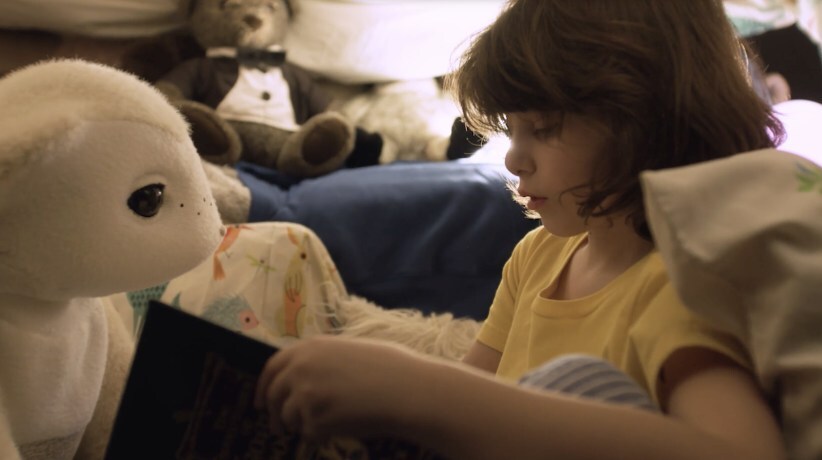
The announcement is described by the company as an emergence from stealth, not a commercial launch. That means there is no pricing, no availability date, no detail on which consumer segments the company is targeting first, and no information about the robot's size or weight.
Crucially for pet owners, there is also no mention of how the Familiar has been tested in homes with existing animals, whether the company has conducted any behavioral research on animal responses to the robot, or what guidance it intends to provide to households with dogs or cats. These are not minor questions. They are the difference between a product that integrates smoothly into a home and one that becomes a source of daily stress for the animals already living there.