

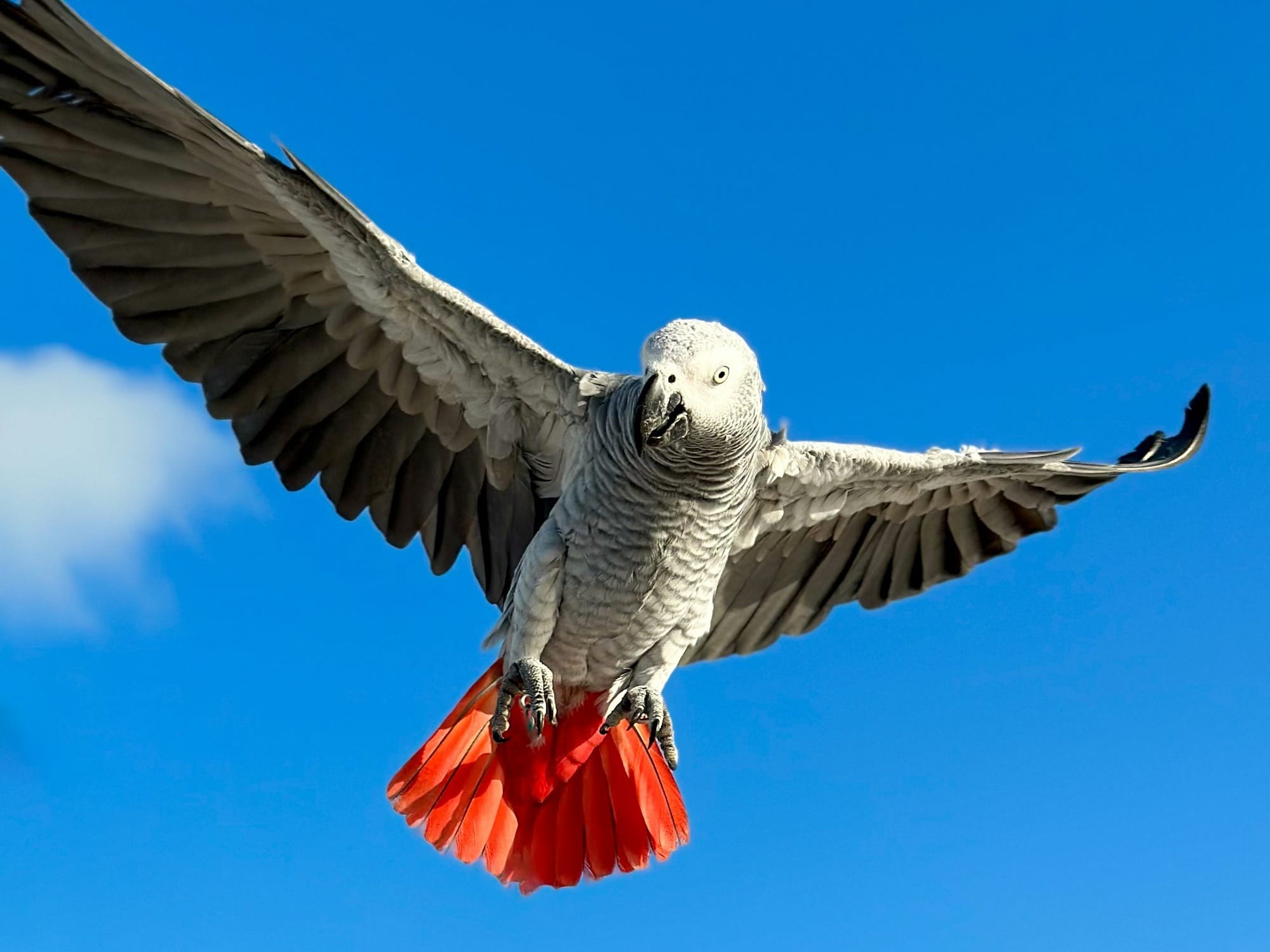
A regulatory nudge wrapped in celebration: The government's new advisory stops short of a ban, but its language signals that stricter rules for parrot owners could be coming.
Singapore's government has issued its first formal advisory warning pet owners about the risks of free-flying parrots in the city-state's dense urban environment — a practice that is growing in popularity but that officials now say requires advanced training and carries serious hazards.
The advisory, released by the Animal and Veterinary Service (AVS) on 30 May 2026 and announced by Minister of State for National Development Alvin Tan at the inaugural Friends of Parrots Day event, does not ban the practice. However, its tone and language suggest the government is watching closely, and may foreshadow future licensing or competency requirements for owners who let their birds fly outdoors.
The advisory was released alongside a revised 180-page Parrot Care Handbook developed by the Parrot Society (Singapore) (PSS) and supported by AVS — a document that both organisations describe as a response to widespread misinformation in the local parrot-keeping community. Taken together, the two releases mark the most significant government intervention in parrot welfare standards Singapore has seen.
• The AVS has issued Singapore's first advisory on parrot free-flying, citing risks including bird attacks, building collisions, and permanent loss of the pet.
• Minister of State Alvin Tan said on Channel News Asia that free-flying 'requires a lot of advanced skill training,' language that may hint at future regulation.
• The revised Parrot Care Handbook, now freely downloadable, is 180 pages and was developed with an avian veterinarian and a certified parrot behavioural consultant.
• The advisory does not ban free-flying but encourages owners to consider indoor flight sessions and interactive toys as safer alternatives.
• The announcements were made at Friends of Parrots Day at Jurong Lake Gardens — Singapore's first event dedicated to parrot care.
When Freedom Becomes a Risk: The Parrot Free-Flying AVS Advisory Explained
Free-flying is not a casual hobby. It involves training a bird to fly in open outdoor spaces and return to its owner on verbal or gestured command. Practitioners argue it is the closest a captive parrot can come to replicating its life in the wild. Maybelline Tan, president and founder of the Parrot Society (Singapore), explained the welfare logic on Channel News Asia: 'If you understand how parrots live in the wild, they actually live in vast vast spaces, so they do fly many kilometres per day. So they do need that kind of level of exercise to replicate how they live in the wild.'
But Singapore's urban landscape introduces dangers that open countryside does not. The AVS advisory specifically flags attacks by other birds and animals, collisions with glass-facade buildings, disorientation, and the risk that a bird simply does not return. Minister Tan, speaking to Channel News Asia, put it plainly: 'There is a risk for the parrots to fly, be disoriented as well as not coming back to where their owners are. So this advisory will help owners understand the risks of parrot free-flying which requires a lot of advanced skill training and also apprise them of the risks involved in such an activity.'
Some practitioners push back on the framing. Kenneth Lim, a member of the free-flying group Freedom Flyer, told Channel News Asia: 'Most of our parrots here I would say 100% they are all being well trained. And parrots do not attack any people walking around there unnecessarily because they are well trained and we actually trained on recall basis meaning the birds will actually fly back to us.' The tension between welfare advocates and experienced practitioners is likely to define this debate going forward. The full advisory is available on the AVS website at https://go.gov.sg/free-flying-advisory.
Why This Matters: Singapore's Growing Bond With Pet Birds
The advisory and handbook arrive at a moment when Singapore's relationship with pets is deepening rapidly. According to Locad in 2024, 32% of people in Singapore own pets, with the pet care market generating S$195 million in pet food revenue and S$217.6 million in overall pet care product sales that year. According to Deep Market Insights in 2024, the Singapore pet services market was valued at USD 306.29 million in 2024 and is projected to reach USD 644 million by 2033, growing at a compound annual growth rate of 8.63%. Birds are a meaningful slice of that growth.
The welfare stakes are real. According to research published in PLOS ONE and indexed by the National Institutes of Health in 2021, feather-damaging behaviour affects an estimated 10 to 17.5% of captive parrots globally and is considered a key welfare indicator of stress caused by unsuitable environments and poor management. That figure gives weight to PSS's concern about misinformation: A poorly kept parrot is not merely unhappy, it is likely to show measurable physical signs of distress. The handbook is, in part, a response to that documented welfare gap.sz
The Handbook and the Event: What Was Actually Launched
The Parrot Care Handbook was first released in December 2025 and has now been revised and made available as a free downloadable e-book on the PSS website at https://parrotsocietysg.org/handbook/. At 180 pages, it covers parrot behaviour, nutrition, enrichment, and welfare, and was developed in consultation with an avian veterinarian and a certified parrot behavioural consultant. PSS said it created the handbook after observing 'misinformation and misunderstanding about proper parrot care practices in the community' through interactions with pet owners, pet shops, and community groups.
Friends of Parrots Day, held at the Gardenhouse at Jurong Lake Gardens, featured close to 20 booths, free family-friendly activities, and six educational talks by avian and wildlife experts. Topics ranged from creating a safe home environment for parrots to the illegal wildlife trade. The event was timed to coincide with World Parrot Day weekend.
The Urban Constraint That Shapes Everything
Understanding why Singapore's government treats parrot welfare with such regulatory attention requires understanding the city-state's housing reality. According to the U.S. International Trade Administration in 2023, approximately 80% of Singapore's resident population lives in public housing (HDB flats), where pet ownership is subject to stricter rules than in private properties. For parrot owners in HDB flats, space is already constrained and the appeal of free-flying, which offers a bird the open air it cannot get indoors, becomes easier to understand in that context.
That same density, however, is precisely what makes free-flying more dangerous in Singapore than in less urbanised environments. Glass-facade buildings, which the advisory specifically cites as collision hazards, are a defining feature of Singapore's skyline.
What This Means If You Own a Parrot in Singapore
If you currently free-fly your parrot, the advisory does not require you to stop. However, it is a clear signal that the government considers the practice high-risk and expects owners to treat it as such. AVS recommends considering alternatives including indoor flight sessions and interactive toys for mental stimulation and physical exercise in a controlled environment. Owners who continue to free-fly should ensure their birds have undergone thorough recall training and should avoid areas with glass buildings, birds of prey, or other animals that could pose a threat.
If you are a new or prospective parrot owner, the Parrot Care Handbook is worth downloading regardless of your views on free-flying. It is free, science-based, and 180 pages long, a more substantial resource than most pet-care guides available in Singapore. The broader message from both AVS and PSS is consistent: Parrots are long-commitment animals with complex welfare needs, and owners who go in underprepared are likely to struggle.
Singapore has not banned parrot free-flying. But it has done something that often precedes a ban: It has put the practice on the official record as risky, attached a government name to that assessment, and published it alongside guidance that steers owners toward safer alternatives. Whether that represents the end of regulatory interest in free-flying or the beginning of a longer conversation will depend, in part, on how the parrot-keeping community responds and on what data AVS accumulates in the months ahead. For now, parrot owners in Singapore have more resources, more scrutiny, and considerably less ambiguity about where the government stands.