


The serving guide on your cat food packaging was not written with your couch-loving, neutered indoor cat in mind.
Here is a number that should stop every cat owner in their tracks: 61% of cats are classified as overweight or obese and 28% of owners whose cats fall into that category genuinely believe their pet is a perfectly healthy weight [1]. The gap between reality and perception is enormous, and a large part of the problem sits right there on the kitchen counter: The pet food bag.
Feeding instructions on pet food labels are based on the needs of an average cat, which may expend significantly more energy than a typical sedentary indoor cat [4, 11]. If your cat lives entirely indoors, has been spayed or neutered, and spends most of the day sleeping somewhere in the house, which describes the majority of pet cats in Singapore, the bag's recommended portion is almost certainly more food than your cat needs. Here is what the evidence actually says.
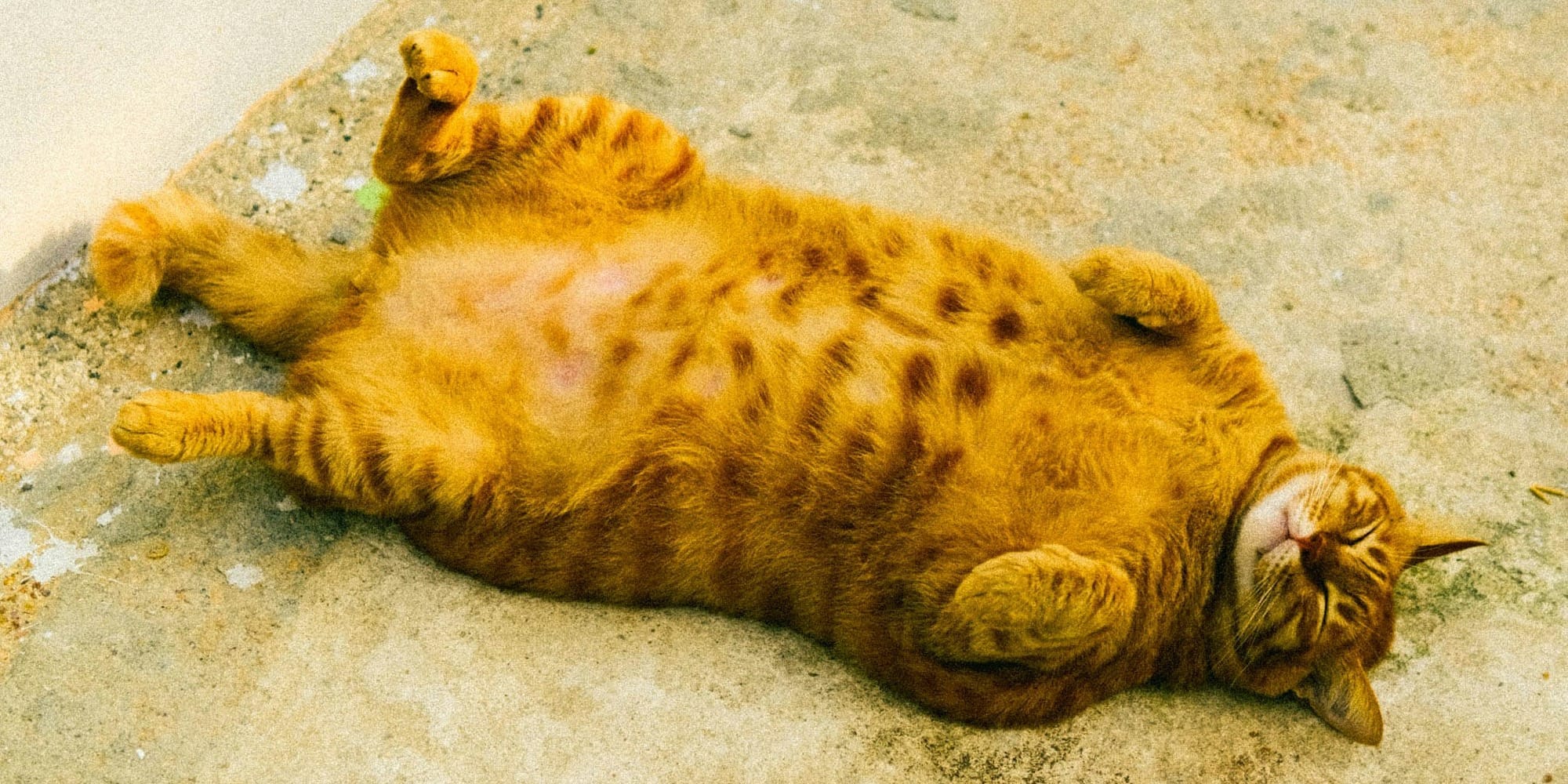
"61% of cats are classified as overweight or obese — but 28% of owners with an overweight cat believe their pet is at a healthy weight. [1]"
• More than six in ten cats are overweight or obese, yet most owners do not recognise it in their own pet [1].
• Pet food label guidelines are a starting point only and are not tailored to sedentary indoor cat. Actual individual energy requirements can vary by as much as 50% [9, 11].
• Spaying or neutering can reduce a cat's maintenance energy requirement by as much as 25%, making a portion reduction of 20–30% appropriate after the procedure [5, 8].
• Weighing food in grams on a kitchen scale is significantly more accurate than using a measuring cup [7, 8].
• Obesity in cats is linked to diabetes mellitus, osteoarthritis, and cardiovascular impairment — obese cats are four-and-a-half times more likely to develop diabetes [4, 6].
• Environmental enrichment tools such as food puzzles can help sedentary cats burn extra calories while satisfying their natural hunting instincts [3, 8].
Why It Matters: Why Is My Indoor Cat Getting Fat?
Indoor cats expend fewer calories than cats with outdoor access because they do not have to hunt for meals and are generally more sedentary [2, 5]. In the wild — or even in an outdoor domestic setting, a cat walks, stalks, climbs, and pounces to earn every meal. An indoor cat walks from the sofa to the food bowl. The caloric maths are very different.
The health consequences of getting this wrong are serious. Feline obesity is associated with a higher incidence of diabetes mellitus, osteoarthritis, and cardiovascular impairment [4, 6]. Obese cats are four-and-a-half times more likely to develop diabetes and twice as likely to die in middle age compared to cats at an optimal weight [4, 6]. These are life-shortening conditions that are largely preventable through portion control.
Allowing cats constant access to food through free-feeding often leads to overconsumption compared to structured meal times, and calories from treats and table food frequently go uncounted [3, 6, 11]. Treats and extras should not exceed 10% of a cat's total daily intake [3, 6, 11]. It is surprisingly easy for the numbers to creep up without any single meal looking excessive.

Warning Signs If Neglected
One of the most insidious things about feline obesity is how gradual it is and how easy it is to miss. Physical signs of obesity include ribs that are not palpable under a heavy layer of fat, a distended abdomen, and the absence of a visible waistline [6]. There may also be heavy fat deposits over the lumbar area, face, and limbs [6].
Veterinarians use a nine-point Body Condition Score (BCS) system to assess this more precisely, where a score of 4.5 to 5 indicates ideal weight and scores of 8 or above signify that a cat is severely overweight or obese [6, 9]. You do not need clinical training to do a basic version of this at home. If you cannot feel your cat's ribs without pressing firmly, or if you cannot see a waistline when you look at your cat from above, those are meaningful warning signs worth raising with your vet.
 Scav
Scav
If weight gain goes unaddressed, the trajectory is well established. The disease associations reflect outcomes observed in real cat populations [4, 6]. Catching the problem early, before a BCS of 8 or above, is far easier than reversing entrenched obesity later.
Which Cats Need Extra Attention
Not all cats face the same level of risk. Indoor cats and neutered cats are at higher risk for weight gain, and these two categories overlap heavily in Singapore, where the vast majority of pet cats are kept indoors and desexed as a matter of routine [5, 8].
Spaying or neutering significantly reduces a cat's maintenance energy requirement — research indicates this reduction can be as much as 25% compared to intact cats [5]. This means that if you have been feeding your cat the same amount since before they were desexed, they have almost certainly been in a caloric surplus ever since. The recommended response is to decrease the amount of food by 20% to 30% immediately after a spay or neuter procedure, accounting for the decreased energy requirements that occur shortly after surgery while the cat is still maturing [8].
How Often Should You Monitor Your Cat's Weight?
Nutritional assessments are recommended during every routine veterinary visit, treated as a fifth vital sign alongside temperature, pulse, respiration, and blood pressure [6, 9, 11]. Between vet visits, owners can monitor weight and body condition at home by using a baby scale and performing regular rib and profile checks [6, 9, 11]. Catching small gains early before they compound is far easier than reversing established obesity, so building this into a monthly routine is genuinely worthwhile.

How to Do It: Calculating and Measuring the Right Portion
Calculating your cat's actual calorie needs involves a bit of simple arithmetic. One commonly used equation for a cat at ideal weight is: 30 multiplied by body weight in kilograms, plus 70 [2, 11]. Alternatively, practitioners calculate the Resting Energy Requirement as weight in kilograms raised to the power of 0.75, multiplied by 70, then apply a life-stage factor — for example, 1.2 for neutered adult cats [2, 11]. These formulas give you a daily kilocalorie target, which you can then match to the caloric density listed on your food packaging. Your vet can help you work through this calculation and interpret the result.
Because individual energy requirements can vary by as much as 50% between cats of the same size and life stage, label guidelines are only a starting point [9]. If your cat is gaining weight on the suggested serving, that serving is too large for your specific animal — regardless of what the bag says [4, 11].
Once you have a calorie target, how you measure the food matters enormously. Weighing food in grams on a kitchen scale is significantly more accurate than using a measuring cup [7, 8]. Volume-based measurements with cups often lead to overfeeding because it is challenging to level them precisely, and this is compounded by differences in kibble size and density [7, 8]. A small kitchen scale — inexpensive and widely available — removes this variable entirely. If a cat is already overweight, a weight-loss calorie target may be set at approximately 70% of their maintenance requirement, but this should only be done under veterinary supervision [2].
Products and Tools to Use
A basic digital kitchen scale capable of measuring in grams is the single most impactful tool for any cat owner concerned about portion accuracy [7, 8]. If you are currently scooping with a cup, switching to weight-based measuring is likely to reveal you have been overfeeding — and correcting it requires no change in routine beyond a one-off equipment upgrade.
Beyond the scale, food puzzles, dispensing toys, and the practice of spreading small portions of the daily meal in different dishes around the home can help sedentary cats burn extra calories while satisfying their natural predatory instincts [3, 8]. These tools are particularly valuable for indoor cats who would otherwise spend meals standing motionless at a bowl — they introduce movement, mental stimulation, and a more naturalistic feeding experience without adding calories [3, 8].

When to See the Vet
Before starting any weight reduction programme, health screenings — including blood and urine testing — are advisable to identify medical conditions that may predispose a cat to obesity [6, 8]. Weight loss should be gradual, targeting roughly one to two percent of body weight per week, because rapid or sudden caloric restriction can trigger hepatic lipidosis, a serious liver condition [6, 8]. Any meaningful dietary change, including the post-neuter reduction and any ongoing weight management, warrants a conversation with your veterinarian, who can tailor targets to your individual cat's health status and monitor progress over time [6, 9, 11].
Frequently Asked Questions
How much should I feed my indoor cat each day?
There is no single universal answer because individual energy requirements can vary by as much as 50% between cats [9]. A useful starting calculation is 30 multiplied by your cat's ideal body weight in kilograms, plus 70, to give a daily kilocalorie target [2, 11]. You then match that figure to the caloric density on your food packaging. Because label recommendations are based on an average cat and are not standardised, they are a starting point only — especially for sedentary indoor cats who expend less energy than the average [4, 11]. Weigh portions on a kitchen scale rather than measuring by cup for the most accurate results [7, 8].
Why is my indoor cat getting fat even though I follow the bag instructions?
Feeding instructions on pet food labels are based on the needs of an average cat, which may expend significantly more energy than a typical sedentary indoor cat [4, 11]. Indoor cats do not hunt for meals and are generally more sedentary, meaning they need fewer calories than the label assumes [2, 5]. If your cat has also been spayed or neutered, their maintenance energy requirement may be as much as 25% lower than that of an intact cat [5]. Free-feeding and uncounted treat calories compound the problem further [3, 6, 11].
What are my neutered cat's daily calorie needs?
After spaying or neutering, a cat's maintenance energy requirement drops substantially — research shows a reduction of as much as 25% compared to intact cats [5]. A common approach is to reduce food intake by 20% to 30% immediately after the procedure [8]. For an ongoing estimate, practitioners calculate the Resting Energy Requirement as weight in kilograms raised to the power of 0.75, multiplied by 70, and then apply a life-stage factor of 1.2 for neutered adults [2, 11]. Your vet can help calculate a precise target for your individual cat.
Are pet food bag feeding guidelines accurate for indoor cats?
Not necessarily. Label guidelines are described by veterinary nutrition bodies as a starting point only [9, 11]. They are based on a generic average cat and are not standardised across manufacturers, and they do not account for the lower energy expenditure of sedentary indoor or neutered cats [4, 11]. Individual caloric requirements can vary by as much as 50% [9], which means the right portion for your cat could be substantially less than the bag suggests.
How do I check my cat's body condition score at home?
Veterinarians use a nine-point Body Condition Score (BCS) scale, where a score of 4.5 to 5 indicates ideal weight and a score of 8 or above indicates severe overweight or obesity [6, 9]. At home, you can perform a basic check by running your hands along your cat's sides — ribs should be easy to feel without pressing hard [6]. Look at your cat from above: There should be a visible waistline behind the ribcage [6]. You can also monitor weight regularly using a baby scale [6, 9, 11]. If ribs are buried under a layer of fat, the abdomen appears distended, or no waistline is visible, a vet visit is warranted [6].
Should I weigh my cat's food instead of using a measuring cup?
Weighing food in grams on a kitchen scale is significantly more accurate than using a measuring cup [7, 8]. Cup measurements are difficult to level precisely, and accuracy varies with different kibble sizes and densities, which often leads to unintentional overfeeding [7, 8]. A basic digital kitchen scale removes this variable and ensures portions are consistent every day [7, 8].
The bag on your shelf was designed for an average cat. Your cat — lounging indoors, likely neutered, probably not sprinting after prey multiple times a day — is almost certainly not that cat. Getting portions right does not require a nutrition degree; it requires a kitchen scale, a simple calculation, and a willingness to adjust when the number on the scale at your next vet visit tells you something.
Small changes made consistently have an outsized impact on a cat's long-term health and quality of life. When in doubt, your vet is the best person to help you land on the right number for your specific animal.
[1] APOP 2022 Pet Obesity Prevalence Survey: 61% of US cats overweight or obese, owner perception gap
[2] Cornell Ask Elizabeth: indoor-cat overfeeding case study and weight-loss calorie target (70% of maintenance)
[3] VCA Animal Hospitals: free feeding contributes to obesity in sedentary indoor cats, food-puzzle enrichment
[4] Cornell on feeding frequency and obesity-linked disease rates from their 2,000-cat follow-up study
[5] Mitsuhashi et al 2011, Maintenance energy requirement determination of cats after spaying: spayed cats need 25% less MER than NRC recommendation for intact
[6] Cornell Feline Health Center on obesity: BCS scale, prevalence, definition of feline obesity, disease consequences
[7] Tufts Petfoodology: weighing food in grams vs measuring in cups, worked example for a 12lb cat
[8] Tufts Petfoodology: indoor and neutered cats at higher obesity risk, 20-30% calorie reduction recommended after neuter
[9] WSAVA Global Nutrition Assessment Guidelines (JSAP 2011): MER varies by up to 50% in cats; label recommendations are only a starting point
[10] WSAVA Global Nutrition Toolkit: starting-point calorie charts and feeding assessment framework for healthy cats
[11] 2021 AAHA Nutrition and Weight Management Guidelines for Dogs and Cats: RER/MER, BCS, MCS, nutritional assessment at every visit
Note: Some of the sources cited here are published by international veterinary authorities and may not be directly accessible from all regions. The reference is provided as a record of where the information comes from. For a clear indication of our editorial policy, please click here.