


That innocent-looking lump on your dog could be far more serious than a bug bite.
Mast cell tumours are one of the most deceptive cancers in veterinary medicine. In dogs, they are the most common malignant skin tumour, accounting for 11% to 21% of all skin neoplasms, while in cats they rank as the second most common skin tumour [2, 3, 6, 7, 10]. The problem? These growths can look exactly like an ordinary wart or insect bite, even as they quietly release inflammatory chemicals that can affect the entire body. Knowing the signs early could make all the difference for your pet.
If your pet shows any of these signs, go to an emergency vet immediately:
•Anaphylactic reaction (life-threatening allergic response from massive histamine release)
•Hypotensive shock or circulatory collapse
•Bloody vomit
•Black, tarry stools indicating severe gastrointestinal bleeding
•Signs consistent with intestinal perforation, peritonitis, or sepsis in advanced or untreated cases
• In dogs, mast cell tumours are the most common malignant skin tumour, making up 11% to 21% of all canine skin neoplasms [2, 3, 6, 7, 10].
• Approximately 85% of affected dogs develop just one tumour initially, so a single suspicious lump always warrants a vet check [1, 9, 10].
• Breed risk is significant — Boxers and Boston Terriers alone account for roughly 50% of all canine cases [3, 7, 9, 10].
• In cats, the intestinal form can cause vomiting, weight loss, and bloody stools, and often carries a more guarded outlook than the skin form [4, 5, 8].
• Emergency signs including anaphylactic reactions, bloody vomit, and black tarry stools require immediate veterinary attention [3, 10].
• Prognosis varies significantly by grade — low-grade canine tumours often achieve survival times of over two years with surgery, while high-grade tumours may carry a median survival of less than four months [2, 4, 5, 6, 10].
What Are Mast Cell Tumours and Which Pets Are at Risk?
Mast cell tumours are hematopoietic neoplasms, essentially cancers originating from blood-forming tissue. They are composed of mast cells, which are specialised immune cells that normally release granules containing histamine and heparin during allergic reactions [2, 3, 6, 7, 10]. When these cells become cancerous, they can release those same chemicals unpredictably, triggering a cascade of systemic symptoms that go far beyond a lump on the skin.
"A lump that changes size from day to day — growing and shrinking as it releases inflammatory chemicals — is a key warning sign of a mast cell tumour in dogs and should be assessed by a veterinarian immediately [1, 9, 10]."
Dogs are by far the most commonly affected companion animal, but cats, horses, cattle, pigs, birds such as chickens and owls, and reptiles such as geckos and tortoises have all been documented with this disease [2, 3, 6, 7, 10]. For pet owners in Singapore, where dogs and cats are the most common household companions, understanding which animals are most vulnerable is an important first step.

In dogs, certain breeds carry a substantially higher risk. Boxers, Boston terriers, pugs, English bulldogs, golden retrievers, Labrador retrievers, and shar-peis are among the most predisposed breeds, and boxers and Boston terriers alone account for approximately 50% of all canine cases [3, 7, 9, 10]. Retriever breeds and other brachycephalic (flat-faced) breeds also appear frequently in clinical records [3, 7, 9, 10].
For cats, age is the biggest risk factor. Feline mast cell tumours typically affect older cats with an average age of 10 years [4, 6, 7, 8]. A specific histiocytic type of the tumour is recognised primarily in Siamese cats younger than four years old, making Siamese cats the breed most commonly associated with the disease in the general feline population [4, 6, 7, 8]. The cutaneous (skin) form in cats is generally considered more benign than the equivalent form found in dogs [4, 6, 7, 8].

Signs to Look Out For: From That First Lump to Advanced Disease
Early signs in dogs are notoriously easy to dismiss. A solitary lump or bump on or just under the skin that is raised, possibly reddened, and irritating enough for the dog to scratch, lick, or bite is the typical first presentation [1, 9, 10]. These masses can look almost identical to innocent insect bites or warts, and they may fluctuate in size from day to day as they release inflammatory chemicals, which is an important distinguishing feature [1, 9, 10]. If you notice a lump on your dog that seems to change in appearance, do not wait to see if it resolves on its own.
As the disease progresses or spreads in dogs, signs become more systemic. Advanced-stage indicators include tumours spreading to regional lymph nodes, the liver, and the spleen, sometimes causing a visibly rounded or swollen abdomen due to fluid build-up [3, 6, 9]. Complications from chronic histamine release include persistent vomiting, weight loss, and widespread skin bruising (known as ecchymosis) around tumour sites [3, 6, 9]. In the most severe cases, mast cells may be detected in the peripheral blood (a condition called mastocythemia) or may involve the bone marrow [3, 6, 9].
In cats, the picture varies depending on where the tumour is located. Cats with the visceral or intestinal form frequently present with classic signs of systemic illness: Vomiting, appetite loss, weight loss, diarrhoea, and lethargy [4, 5, 8]. Fresh red blood may appear in the stool, or the stool may turn black and tar-coloured due to digested blood (a condition called melaena) [4, 5, 8]. Some cats also develop fluid build-up in the abdomen, known as effusion, as the disease spreads to neighbouring organs [4, 5, 8].

Certain symptoms in dogs constitute a genuine emergency and require immediate veterinary care. Massive histamine release can lead to life-threatening anaphylactic reactions, hypotensive shock, or circulatory collapse [3, 10]. Severe gastrointestinal bleeding, characterised by bloody vomit or black, tarry stools, can result from gastroduodenal ulceration, and intestinal perforation, peritonitis, and sepsis are also critical complications in advanced or untreated cases [3, 10]. If your dog shows any of these signs, go straight to an emergency vet clinic.
 Preventive
How Vets Diagnose Mast Cell Tumours
When a suspicious lump is found, the first diagnostic step for both dogs and cats is typically a fine needle aspiration and cytology [1, 3, 5, 8, 10, 11]. In this procedure, a veterinarian inserts a small needle into the mass to collect cells, which are then examined under a microscope for the characteristic purple or basophilic (blue-staining) granules found inside mast cells [1, 3, 5, 8, 10, 11]. This technique is highly accurate and is usually performed in-clinic with minimal stress to the patient.
However, a cytology result alone cannot tell the whole story. A tissue biopsy and histopathological grading where a larger sample is sent to a laboratory for detailed analysis are necessary to determine how aggressive the tumour is and to predict the likely prognosis [1, 3, 5, 8, 10, 11]. The grade essentially tells your vet how likely the cancer is to spread and how urgently it needs to be treated.
For suspected internal tumours in both dogs and cats, ultrasound or CT scans may be required to visualise masses in the liver, spleen, or gastrointestinal tract [1, 3, 5, 8, 10, 11]. These imaging tools are especially important in cats with the visceral form of the disease, where the primary problem may not be visible from the outside at all. Consulting a veterinary oncologist for complex cases is always worth exploring.
Mast Cell Tumour Treatment Options for Dogs and Cats
Treatment is never one-size-fits-all, and a vet or veterinary oncologist will tailor a plan based on the species, location, grade, and extent of the disease. Understanding the range of options from conservative management to surgery can help you have a more informed conversation with your care team.
At the conservative end, oral medications such as corticosteroids like prednisone can reduce inflammation and inhibit tumour growth in dogs [1, 3, 10, 12]. Histamine blockers and antacids such as diphenhydramine and famotidine are used to manage systemic side effects and protect against gastrointestinal ulcers caused by excess histamine [1, 3, 10, 12]. For aggressive or tumours that cannot be surgically removed, targeted drug therapies called tyrosine kinase inhibitors, such as toceranib phosphate (sold as Palladia), offer a non-surgical route to slowing the disease [1, 3, 10, 12].
For most cases in both dogs and cats, surgery remains the primary and most definitive treatment [3, 4, 5, 10, 11]. Surgical excision typically involves removing wide margins of healthy tissue around the tumour to reduce the risk of regrowth [3, 4, 5, 10, 11]. In cats with the splenic form of the disease, a splenectomy (surgical removal of the spleen) is the recommended approach and can lead to rapid recovery [3, 4, 5, 10, 11].
Radiation therapy is another option, used as follow-up treatment when surgery was incomplete or when the tumour is in a location that cannot be easily resected, such as around the face or paws [3, 4, 5, 10, 11]. In some cases, a combination of surgery, radiation, and targeted medication provides the best outcome. Every pet is different, so working closely with your veterinarian or a specialist in veterinary oncology is essential.

Prognosis by Grade: What the Outlook Looks Like
Understanding the likely outcome for your pet starts with knowing the grade of the tumour, which is determined through histopathology after biopsy. In dogs, prognosis is closely tied to this grading: Low-grade tumours often carry survival times of over two years with surgery, while high-grade tumours may have a median survival time of less than four months [2, 4, 5, 6, 10].
The picture for cats depends heavily on which form of the disease is present. Cats with cutaneous (skin) mast cell tumours generally have a good prognosis with low recurrence rates [2, 4, 5, 6, 10]. Those treated with splenectomy for the splenic visceral form have a median survival of approximately 14 months [2, 4, 5, 6, 10]. Intestinal mast cell tumours in cats carry a more guarded prognosis, though aggressive treatment can extend life for one to two years [2, 4, 5, 6, 10]. These figures offer a framework, but every pet's response to treatment is individual. Early detection and prompt intervention consistently offer the best chance of a positive outcome.
Frequently Asked Questions
What are the signs of a mast cell tumour in dogs?
Early signs in dogs typically involve a solitary lump or bump on or just under the skin that may be raised, reddened, and irritating enough for the dog to scratch, lick, or bite [1, 9, 10]. These masses can look like insect bites or warts and may fluctuate in size daily as they release inflammatory chemicals [1, 9, 10]. In later stages, signs include a swollen abdomen, persistent vomiting, weight loss, and skin bruising around tumour sites [3, 6, 9]. In emergencies, anaphylactic shock or bloody, tarry stools require immediate veterinary attention [3, 10].
What are the symptoms of a mast cell tumour in cats?
In cats, symptoms vary by tumour location. Skin tumours may present as visible lumps that are generally more benign than those in dogs [4, 6, 7, 8]. Cats with the visceral or intestinal form often show vomiting, appetite loss, weight loss, diarrhoea, and lethargy [4, 5, 8]. Stools may contain fresh blood or appear black and tar-coloured due to internal bleeding [4, 5, 8]. Some cats also develop fluid build-up in the abdomen, known as effusion, as the disease progresses [4, 5, 8].
What does a mast cell tumour look like on a dog or cat?
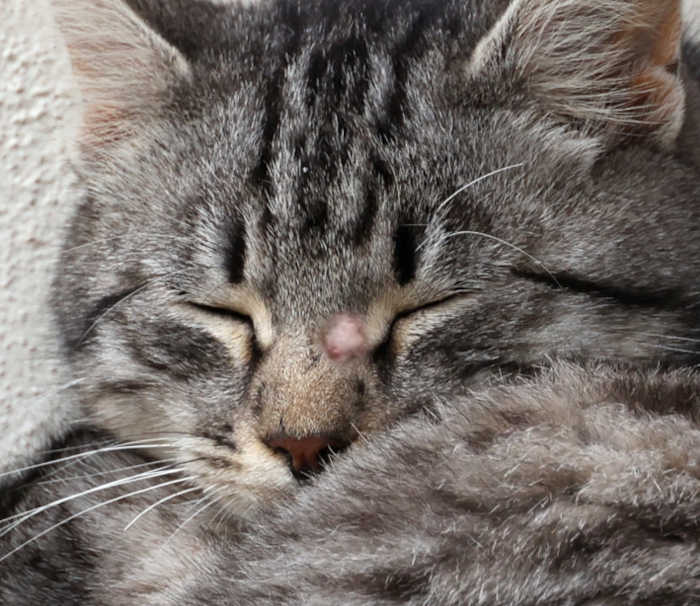
In dogs, a mast cell tumour on the skin often looks like a raised, reddened lump that can resemble an insect bite or wart, and it may change in size from day to day [1, 9, 10]. This fluctuation in appearance is a key warning sign. In cats, the cutaneous form may also appear as a skin nodule [4, 6, 7, 8]. Because these tumours can so closely mimic benign skin conditions, any new or changing lump should be assessed by a veterinarian promptly.
What are the treatment options for mast cell tumours in dogs and cats?
Treatment ranges from conservative to surgical depending on the grade and location of the tumour. Conservative options for dogs include corticosteroids like prednisone to reduce inflammation, histamine blockers and antacids such as diphenhydramine and famotidine to manage systemic effects, and tyrosine kinase inhibitors such as toceranib phosphate (Palladia) for aggressive or non-resectable cases [1, 3, 10, 12]. For both dogs and cats, surgical excision with wide tissue margins is the primary treatment [3, 4, 5, 10, 11]. Cats with the splenic form benefit from splenectomy, while radiation therapy can be used as follow-up when surgery is incomplete or not feasible [3, 4, 5, 10, 11].
What is the prognosis for a mast cell tumour by grade?
In dogs, grade is the strongest predictor of outcome. Low-grade tumours often achieve survival times of over two years with surgery, while high-grade tumours may carry a median survival of less than four months [2, 4, 5, 6, 10]. In cats, the cutaneous form generally carries a good prognosis with low recurrence rates, and cats undergoing splenectomy for the visceral form have a median survival of approximately 14 months [2, 4, 5, 6, 10]. The intestinal form in cats is more serious, though aggressive treatment can extend life for one to two years [2, 4, 5, 6, 10].
Which dog breeds are most at risk for mast cell tumours?
Several breeds carry a significantly elevated risk, including boxers, Boston terriers, pugs, English bulldogs, golden retrievers, Labrador retrievers, and shar-peis [3, 7, 9, 10]. Boxers and Boston terriers together account for approximately 50% of all canine mast cell tumour cases [3, 7, 9, 10]. Retriever breeds and other brachycephalic (flat-faced) breeds are also frequently affected [3, 7, 9, 10]. If your dog belongs to one of these breeds, regular skin checks and prompt investigation of any new lumps are especially important.
• What grade is my pet's mast cell tumour, and what does that mean for the recommended treatment plan?
• Should we perform a fine needle aspiration first, or go straight to a biopsy given my pet's presentation?
• Is surgical excision appropriate for my pet's tumour location, and what size of margin would you aim to remove?
• Are there tyrosine kinase inhibitors or other targeted medications that might be suitable if surgery is not possible?
• What monitoring schedule do you recommend after treatment to catch any recurrence early?
• Should I be referred to a veterinary oncologist, and are there specialist oncology services available in Singapore?
Mast cell tumours can be unsettling to discover, but knowledge is a powerful tool. Whether you are a boxer owner who does regular skin checks or a cat parent who has noticed unexplained weight loss, understanding what these tumours look like, how they progress, and what treatment options are available puts you in the best possible position to act quickly. Early detection consistently offers the best chance of a positive outcome, so when in doubt, get that lump checked. Your vet is your most important partner in keeping your pet healthy.
[1] Michigan State University CVM client guide on canine mast cell tumours
[2] Tamlin 2020 comparative review of mast cell neoplasia across mammals, birds and reptiles, with focus on KIT mutations
[3] de Nardi et al. 2022, Brazilian Association of Veterinary Oncology 2nd consensus on canine cutaneous and subcutaneous MCT
[4] Drake Center clinic guide on feline mast cell tumours covering cutaneous, splenic and intestinal forms
[5] NC State Veterinary Hospital oncology service on feline mast cell tumours
[6] Merck Veterinary Manual on cutaneous mast cell tumours across species
[7] American College of Veterinary Surgeons overview of MCT, breed predispositions and surgical management
[8] VCA Animal Hospitals on feline mast cell tumours, all three anatomical forms
[9] VCA Animal Hospitals on canine MCT, prevalence, breed risk and KIT mutation
[10] NC State Veterinary Hospital oncology service on canine mast cell tumours
[11] Cornell University CVM Oncology medical conditions section covering mast cell tumours
[12] Today's Veterinary Practice 2024 review of canine MCT covering newer therapies including tigilanol tiglate and gilvetmab
Note: Some of the sources cited here are published by international veterinary authorities and may not be directly accessible from all regions. The reference is provided as a record of where the information comes from. For a clear indication of our editorial policy, please click here.